The Ultimate Guide to the Backdoor Roth IRA (How to Bypass Income Limits)
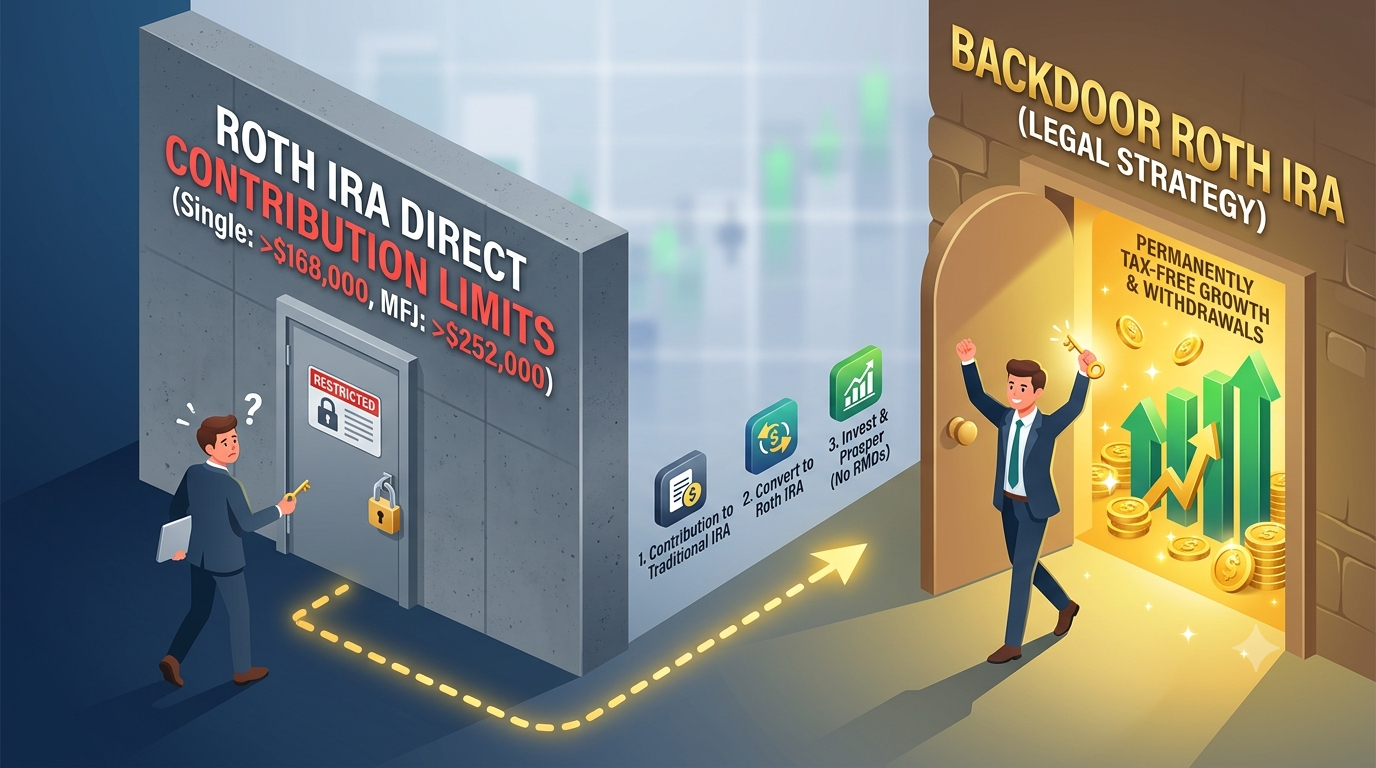
The Backdoor Roth IRA is a powerful tax-planning strategy that allows high-earning individuals to legally bypass IRS income limits and contribute to a Roth IRA.
With benefits like permanently tax-free investment growth, tax-free withdrawals in retirement, and no Required Minimum Distributions (RMDs), this strategy is an annual financial checklist staple for high-income households.
Why Use the “Backdoor”? (The Income Limits Explained)
The IRS places strict income limits on who can make direct contributions to a Roth IRA. For the 2026 tax year, these limits are:
- Single Filers: You cannot contribute directly if your Modified Adjusted Gross Income (MAGI) is over $168,000.
- Married Filing Jointly (MFJ): You cannot contribute directly if your MAGI is over $252,000.
However, there are no income limits on contributing to a Traditional IRA (though high earners cannot deduct these contributions from their taxes—making them “non-deductible contributions”). More importantly, the IRS does not restrict you from converting those Traditional IRA funds into a Roth IRA.
Thus, the Backdoor Roth logic is incredibly simple:
- Contribute money to a Traditional IRA (as a non-deductible, after-tax contribution).
- Convert that Traditional IRA money to a Roth IRA shortly after.
Backdoor Roth Contribution Limits (2026)
- Under Age 50: Up to $7,500 per year.
- Age 50 and Older: Up to $8,600 per year (includes a $1,100 catch-up contribution).
Step-by-Step Execution Guide
Note: Timing and order of execution are critical. A mistake here can lead to unexpected tax bills or unnecessary interest accumulation.
Step 1: Open Both Accounts
If you don’t have them already, open both a Traditional IRA and a Roth IRA with the same brokerage (e.g., Fidelity, Charles Schwab, or Vanguard). Having both accounts at the same institution makes the transfer seamless and fast.
Step 2: Fund Your Traditional IRA
Contribute the maximum annual limit (e.g., $7,500 or $8,600 for 2026) into your Traditional IRA.
- Crucial Tip: Keep this money in cash or a money market fund. Do not purchase any investments yet. You want to avoid any market fluctuations or taxable gains before the conversion.
Step 3: Wait for the Funds to Settle
Wait 1 to 3 business days for your deposit to fully clear. The funds must show as “Available to Convert” or “Cash Available” in your account before you take the next step.
Step 4: Convert to Roth (The “Backdoor” Step)
Log into your brokerage portal and select “Convert to Roth” or “Transfer”. Move the entire balance from your Traditional IRA into your Roth IRA.
- Select “Convert the entire account balance.”
- When asked about withholding taxes (Withholding Election), always select “No withholding.” Since you funded the account with after-tax money, you do not owe taxes on the principal during the conversion.
Step 5: Invest the Money
Once the funds land in your Roth IRA, immediately use them to buy your preferred investments (index funds, ETFs, stocks, etc.). From this point forward, all capital gains, dividends, and future withdrawals will be 100% tax-free.
⚠️ The Golden Pitfall: The Pro-Rata Rule
This is the most common and expensive mistake people make when doing a Backdoor Roth.
The IRS Pro-Rata Rule: When converting IRA funds, the IRS does not let you choose to only convert your “non-deductible (after-tax) dollars.” Instead, they view all your Traditional IRAs, SEP-IRAs, and SIMPLE IRAs combined as one giant pool of money, and tax your conversion proportionally.
An Example of the Trap:
Imagine you have $90,000 of pre-tax money sitting in a Rollover IRA from an old 401(k).
This year, you add $10,000 of after-tax money (non-deductible) into a Traditional IRA and attempt to do a $10,000 Backdoor Roth conversion.
The IRS views your total IRA balance as $100,000, which consists of:
- 90% Pre-tax (untaxed) money
- 10% After-tax (already taxed) money
When you convert $10,000, the IRS deems that 90% of your conversion ($9,000) must come from the pre-tax portion. Therefore, you will owe ordinary income tax on $9,000 of that conversion, completely defeating the purpose of a tax-free backdoor!
💡 The Workaround:
- Empty your Traditional IRAs: Before doing a Backdoor Roth, execute a “Reverse Rollover” by moving any pre-tax IRA balances (Traditional/Rollover/SEP/SIMPLE IRAs) back into your current employer’s active 401(k) plan. Workplace 401(k)s are excluded from the Pro-Rata Rule calculation.
- Ensure that by December 31st of the year you do the conversion, your total balance across all Traditional, SEP, and SIMPLE IRAs is exactly $0.
How to Report It on Your Taxes
In the spring of the following year (e.g., in early 2027 when filing your 2026 tax return), your brokerage will issue a Form 1099-R showing the conversion.
To report this correctly and prove you don’t owe taxes on the transaction, you must fill out Form 8606 (Nondeductible IRAs) with your tax return:
- Part I tracks your non-deductible contribution to the Traditional IRA (establishing your basis).
- Part II documents the conversion of those funds to your Roth IRA.
- When filed correctly, the taxable amount of the conversion on your tax return will be $0.
Disclaimer
This guide is for informational and educational purposes only and does not constitute professional financial, tax, or investment advice. Tax laws are complex and subject to change. Please consult with a Certified Financial Planner (CFP) or a Certified Public Accountant (CPA) regarding your specific financial situation before making investment decisions.